This is a SEO version of Playtimes_1209. Click here to view full version
« Previous Page Table of Contents Next Page »Po Toi O
Po Toi O is a small fshing village on the Clear Water Bay Peninsula in the New Territories. Po Toi O literally means “a sack” in Cantonese – a reference to the sack-like shape of the bay. Interestingly, everyone living in the village near the bay has the same surname: Po.
Pok Fu Lam
Pok Fu Lam, meaning “waterfall bay”, was among the frst places on Hong Kong Island to be visited by European explorers. It was known to ships en route to Guangdong, formerly known in English as Canton, as a reliable source of fresh water. There was little here other than unsanitary squatter residences that remained until the early 1950s. Little further was developed here until the years immediately preceding the outbreak of war with Japan. It was also the place where Hong Kong’s foral emblem, the Bauhinia blakeana , was frst discovered.
Quarry Bay
Quarry Bay is an area beneath Mount Parker on Hong Kong Island. The area was used to quarry rocks from the hillside for construction or road building. Once quarried, the rocks were transported by ship.
Queen’s Pier
The pier has been rebuilt twice. The frst was a wooden structure known offcially known as “Queen’s Statue Wharf”. It was a ceremonial landing area for the British Royal family. The pier was rebuilt in 1925 and given the name “Statue Pier”, but was renamed “Queen’s Pier” a few months later in honour of Queen Victoria.
Repulse Bay
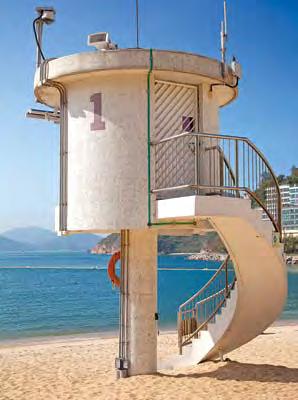
Tsin Shui Wan, as Repulse Bay is known in Chinese, can be translated as “Shallow Water Bay”. However, it acquired its new English name in commemoration of the HMS Repulse, a Royal Navy vessel that visited Hong Kong waters in the 19th century. Repulse Bay was an important strategic location during the Battle of Hong Kong and World War Two. In the 1910s, Repulse Bay was developed into a beach.
Rednaxela Terrace
Rednaxela is Alexander spelled backwards. The street was named as such because the Chinese street sign painter couldn’t read English. Up until the early 20th century, the area comprised a series of dingy terraced streets running off of Shelley Street. They provided “cheek-by-jowl” terraced accommodation for less well-off members of Hong Kong’s local Portuguese community.
P Q
R
Old Peak Road
This was the only road up to The Peak and so the main form of transit until the construction of the Peak Tram in 1888. It was originally just Peak Road, but a newer Peak Road was built on Cheung Chau, and so the name was modifed to Old Peak Road.
Old Bailey Street
Old Bailey Street, located in Central, takes its name from “Old Bailey”, the Central Criminal Court in London. Hong Kong’s frst prison was built on the street in 1841. As the city’s population grew, a larger prison was needed and, in 1925, construction began on what became Stanley Prison.
O
September 2012 101
This is a SEO version of Playtimes_1209. Click here to view full version
« Previous Page Table of Contents Next Page »